


BSFNS — Berlin Strategic & Foreign-affairs Network for Security
Strategic Assessment
The Saudi-Pakistani Defense Pact That Became a Trilateral Deterrence Bloc
From the bilateral SMDA of September 2025 to the Mecca Joint Defence Agreement of August 2026 — tracking the militarization of the Saudi-Pakistani-Turkish axis
By J. Kuttner | August 12, 2026
[Insert featured image here: Mecca Joint Defence Agreement signing ceremony / SMDA-to-Mecca timeline infographic]
Methodological Note
This assessment applies BSFNS's three-tier sourcing framework: (1) facts verified through multiple news sources, (2) official statements attributed to named officials, (3) editorial analysis and strategic interpretation that does not rise to the level of confirmed fact. Analytical passages are clearly marked to distinguish them from verified reporting. This report follows up on BSFNS's August 6, 2026 assessment of Saudi Arabia's nuclear program, which flagged the Saudi-Pakistani defense track as a subject warranting separate, dedicated investigation.
I. From Bilateral Pact to Trilateral Bloc: The Timeline
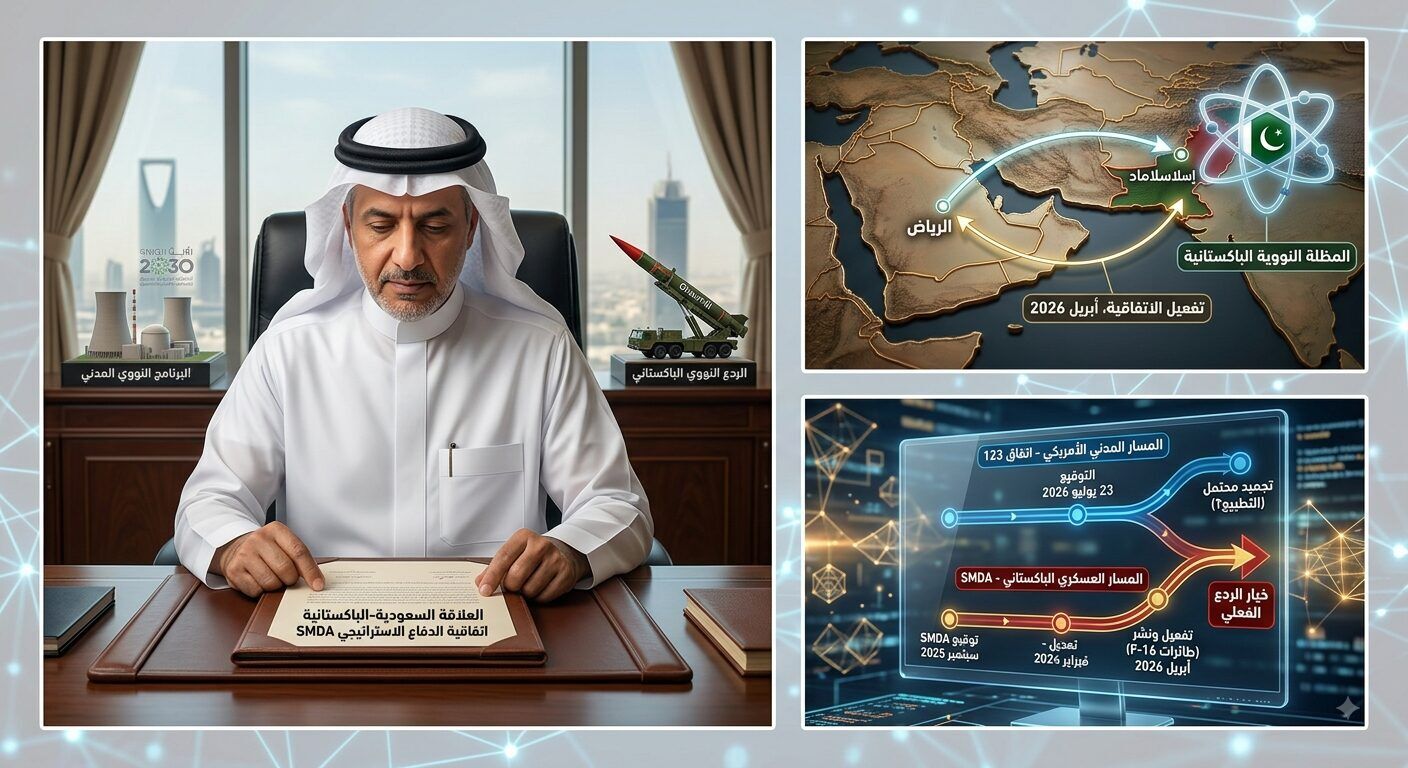
- September 17, 2025 — Saudi Crown Prince Mohammed bin Salman and Pakistani Prime Minister Shehbaz Sharif sign the Strategic Mutual Defence Agreement (SMDA) at Al-Yamamah Palace in Riyadh, declaring that an attack on either country would be treated as an attack on both. The signing follows Israel's September 9, 2025 strike on Hamas leadership in Doha, Qatar, which shook Gulf confidence in U.S. security guarantees.
- February 28, 2026 — The U.S. and Israel launch a war against Iran. Saudi Arabia is subsequently struck repeatedly by Iranian drones and missiles, as well as by Iran-aligned Houthi forces in Yemen and armed groups in Iraq, placing the SMDA under its first real-world stress test.
- April 11, 2026 — Saudi Arabia's Ministry of Defense announces the arrival of a Pakistani military force, including fighter jets and support aircraft, at King Abdulaziz Air Base in the Eastern Province, explicitly invoking the SMDA. Reporting describes a contingent of up to 18 aircraft, with earlier reporting citing a Reuters account of provisions for as many as 80,000 Pakistani troops.
- July 2026 — Pakistan opens talks with Kuwait on an expanded regional security arrangement, signaling the SMDA framework's ambition to grow beyond a bilateral pact.
- August 7, 2026 — Turkish President Recep Tayyip Erdoğan, Saudi Crown Prince Mohammed bin Salman, and Pakistani Prime Minister Shehbaz Sharif sign the "Mecca Joint Defence Agreement" in Mecca, extending the SMDA's collective-defense clause to a third state. The agreement follows nearly a year of negotiations and is signed one day after Sharif, accompanied by Pakistan's army chief Field Marshal Asim Munir, performed Umrah in Mecca.
II. What the Agreements Actually Say
The core clause of both the original SMDA and the new Mecca agreement mirrors NATO's Article 5 language: any armed attack against one signatory is to be regarded as an attack against all. Pakistan's Foreign Office described the original bilateral pact as aiming to "develop aspects of defence cooperation between the two countries and strengthen joint deterrence against any aggression." Saudi Arabia's deputy minister for public diplomacy, Rayed Krimly, stated that the trilateral Mecca pact "is not a threat to any country in the region."
Officials from all three governments have been careful to frame the arrangement as defensive rather than offensive. Pakistan's foreign minister said the agreement "was not directed against any country" and "remained open to other nations in the region." Islamabad-based defense analyst Abdullah Khan cautioned against reading the pact as directed at Iran specifically, despite the timing. Turkey scholar Ünlühisarcıklı described the deal as "a framework for closer strategic, military, and defence-industrial coordination among three influential regional powers" rather than a NATO-equivalent alliance — a caveat echoed by multiple Western analysts.
III. The Nuclear Ambiguity
The most sensitive and contested dimension of the original SMDA concerns the nuclear question, and here the record is genuinely mixed rather than settled.
In a September 18, 2025 interview with Geo TV, Pakistani Defense Minister Khawaja Muhammad Asif stated that "what we have, and the capabilities we possess, will be made available to [Saudi Arabia] according to this agreement" — remarks widely reported as confirming an extended nuclear umbrella. Asif also stated that any attack on either country would trigger a joint response, and left open the possibility of other Arab states joining the framework.
However, in a subsequent interview with Reuters the same week, Asif retracted the implication, stating that nuclear weapons were "not on the radar" of the agreement. Pakistan's Foreign Office spokesman Shafqat Ali Khan avoided a direct answer when pressed on whether the pact altered Pakistan's nuclear doctrine — historically limited to deterring India — saying only that "the doctrine has evolved and continues to do so." The published joint statement accompanying the SMDA does not itself specify a nuclear-sharing provision.
Editorial analysis: The contradiction between Asif's two statements, given within days of each other, is unlikely to be accidental. The more plausible reading is that Islamabad wanted the deterrent signal — aimed primarily at Israel, in the wake of the Doha strike — without accepting the formal costs of an explicit nuclear-sharing commitment, which would invite IAEA scrutiny, jeopardize Pakistan's own nonproliferation standing, and complicate its relations with Washington. The ambiguity itself may be the intended posture: enough to unsettle adversaries, not enough to be pinned down as policy.
IV. The Military Reality on the Ground
Independent of the nuclear question, the SMDA has already produced a measurable military footprint. Pakistan Air Force F-16 Block-52 aircraft participated in the multinational Exercise Spears of Victory-2026 at King Abdulaziz Air Base in January 2026, alongside forces from Saudi Arabia, France, Italy, Greece, Qatar, Bahrain, Jordan, the UK, and the United States. Following the outbreak of the Iran war in February 2026 and subsequent Iranian strikes on Saudi territory, Pakistan's April 2026 deployment to the same base marked what one analysis termed "a qualitative shift from advisory presence to forward-positioned garrison inside an active conflict zone" — a departure from the training-and-advisory role Pakistani personnel had held in the Kingdom since the 1960s.
Any deployment of U.S.-origin F-16s abroad technically requires State Department approval under original Foreign Military Sales terms, a requirement neither government has publicly addressed — leaving open whether the aircraft involved in the April deployment were F-16s, JF-17 Thunder jets (co-developed with China), or a mixed contingent, as conflicting reports suggest.
V. Why Turkey, and Why Now
Editorial analysis: The trilateral expansion to Turkey is best read as Riyadh diversifying its hedge rather than deepening a single dependency. Pakistan supplies battlefield-tested manpower and a nuclear deterrent whose applicability remains deliberately ambiguous; Turkey — a NATO member with the alliance's second-largest military and a fast-growing domestic defense industry — supplies technology-transfer capacity and a degree of Western institutional legitimacy that Pakistan alone cannot offer. Saudi Arabia supplies the financing that binds both partnerships together, consistent with its stated goal of localizing over half of its military procurement by 2030.
The timing — a year of quiet negotiation culminating in a signature during active war conditions — suggests the Mecca agreement was less a reaction to a single event than a hedge deliberately kept in reserve until Gulf confidence in U.S. security guarantees had eroded far enough to justify going public. The February 2026 outbreak of the Iran war, and the exposure of Saudi territory to sustained Iranian drone and missile fire, appears to have supplied that threshold.
VI. Regional and International Reactions
- India: New Delhi has maintained a studied, neutral posture, stating it was aware the SMDA's formalization had been under consideration and would "study its implications" for national security. This calibrated response reflects India's competing interest in preserving its own growing defense relationship with Riyadh (formalized through a 2019 Strategic Partnership Council) while remaining wary of any Pakistani access to Gulf resources or standing.
- Israel and the United States: Neither government issued a strong public objection to the original SMDA's nuclear-adjacent signaling, which several analysts read as tacit prior awareness of the pact's scope and limits.
- China: Beijing was not a party to either agreement but stands to benefit indirectly: deepening Saudi-Pakistani defense ties draw Riyadh closer to a state that is itself a close Chinese partner, and Pakistan's JF-17 fleet — co-developed with China — features in the same deployments now anchoring the SMDA's military footprint.
- Iran: Tehran has not issued a formal response to the Mecca agreement specifically, though its framing as a "not directed against any country" arrangement has done little to dispel the implication, given the immediate wartime context of its signing.
VII. Scenarios Going Forward
The following scenarios are forward-looking, unconfirmed analysis based on information available as of the date of this assessment:
- The Mecca framework remains, for the near term, primarily declaratory and industrial-cooperative in nature — as several Western analysts argue — with its deterrent value resting more on ambiguity and signaling than on any binding operational commitment.
- Further Gulf or Islamic-world states join the framework, formalizing the "Islamic NATO" language Pakistani officials have floated, particularly if Kuwait's talks with Islamabad progress.
- The nuclear ambiguity is deliberately preserved rather than resolved, allowing Riyadh to extract maximum deterrent value from the Pakistani relationship while retaining formal separation from any nuclear-sharing arrangement that would complicate its parallel civilian nuclear negotiations with Washington.
Recommendation for Further Coverage
BSFNS will continue tracking three threads arising from this assessment: (1) the operational details and rules of engagement, if any, governing Pakistani forces stationed on Saudi soil under the SMDA and Mecca frameworks; (2) whether Kuwait or other Gulf states formally join the Mecca agreement; and (3) how the unresolved nuclear ambiguity intersects with the parallel U.S.-Saudi "123 Agreement" civilian nuclear track covered in BSFNS's August 6, 2026 assessment.
BSFNS Strategic Assessment | Berlin Strategic & Foreign-affairs Network for Security


