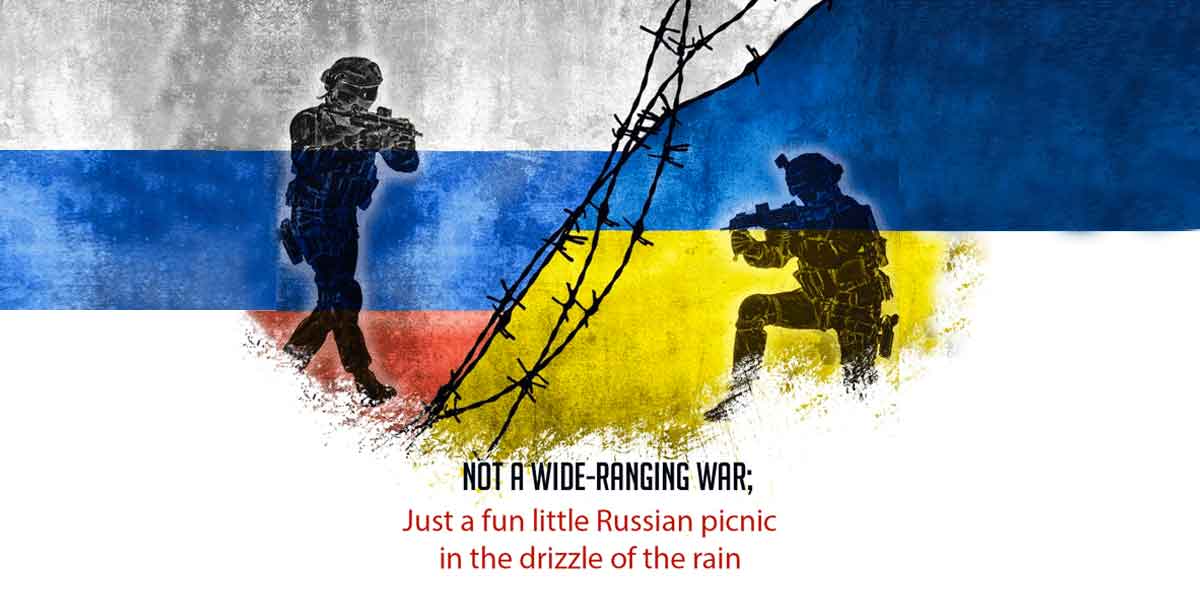
What occurred and occurs in Ukraine?
What are the repercussions of what is up-to-the-minute in the conceivable term? Is it the inauguration of a comprehensive and devastating world war, as some can envisage? What has the United States targeted since its last encounter with China began in 2015? What will international reactions seem like, both among Washington’s allies and among its adversaries? And is there anyone who will emerge victorious from what’s happening now, and who is it?
First of all, to answer the question: “what is happening?”, it must be accentuated that what is taking place is no more than limited skirmishes.
On ground, it is nothing except abolishing the Ukrainian infrastructure and snipping the nails of the ruling regime. It can be regarded as a understated warning to Washington’s allies in Europe – all of them – big powers and minor ones, robust entities and feeble cliques, an unblemished and vibrant message sent by Moscow who is declaring that it is no longer the scrawny and precarious Russia, shattered by the Cold War. It is rather Russia which is now able to guard its national security at a possible price, regardless of the forte of the parties it will face. Russia wanted to present, on the chessboard, an explicit declaration to the whole world the current situation in Ukraine that took place in less than one hour, would be replicated in the countries allied with Washington in Western Europe and others during limited hours only if open hostility with Moscow is declared, forcing it to defend its national security directly and to the best of its ability. As in this and others it will not be able to Washington protects those it considers its friends, while Moscow in this does not do more than what it did in Crimea, Britain in the Falklands, Turkey in northern Cyprus, nor more than what Washington itself did throughout the decade during the last fifty years in all of Latin America – if we consider that what Washington did at the time was in defense of its national security and not as an belligerence against the right of peoples to choose.
Moscow wants simply to defend its national security. It warned against any wide-ranging war it did not want, and signposted, by what it did, that there are routes other than those that Washington sought to inflict on Moscow and NATO together. The American desire was to halt the logjam in the current forced conflict equations, ie the struggle between two blocs of alliances: China and Russia on one side, antagonizing the alliance of the United States and NATO – specifically Western Europe – on the other side. Washington recognized that it would not arise triumphant from this conflict equation. The States is resolutely supposed that; the disruption of the alliance between Moscow and Beijing is in its interest; weakening Russia by conducting a war with Western Europe will be in its interest, even if the price was to detriment Europe in exchange for eradicating Russia from the equation of international conflict. This is to be replaced by a new equation in which the United States is challenging China alone. China does not want wars, if it is its resolve, it will emerge from it defeated – this is how Washington reflects. Thus were its approximations as it pushed for a „restricted“ war in Europe. On the one hand, NATO is no longer the same that Washington dreamed of in the early stages of its establishment, Russia is no longer the same after the collapse of the Berlin Wall and the end of the Cold War and the map of the international alliance has altered. New powers have emerged that can resolve an upcoming international conflict, at least regionally.
During the past week, many attendees of the Security and Defense Conference in Munich agreed that the United States of America, in its valuations since 2015, with regard to its national security issues, has been based on a dubious premise: that any battle in Europe does not completely eliminate Russia from the equation of war and peace in the world, is a losing combat. The main equation says that a war between the United States and its allies on the one hand, against China and Russia on the one hand, will be a devastating war for all, but it will end the United States and Europe completely, and it will be with the calculations of survival and annihilation in favor of Russia and China and not in favor of the United States and NATO. In the sense that Washington must prevent a comprehensive global war, at the expense of limited wars here and there that lead to the weakening of its opponents. Washington has forgotten that it is no longer the only party that can choose the timing of war and peace in the world, and that it is no longer the only one that can take action and leave reactions to others. Washington also forgot that the Russian silence, which has persisted for more than twenty years on Washington’s policies in Europe, does not mean Moscow’s agreement to break the agreements signed after the fall of the Berlin Wall and the dissolution of the Soviet Union, as well as everything related to the non-expansion of NATO in Europe. By violating Washington’s agreements, Moscow is now freed from any obligation related to, not only the independence of the former Soviet republics, but also the independence of all the former members of the Warsaw Pact. Especially those who have become members of NATO and have explicitly and directly harmed the Russian national security, both militarily and economically.
What ensued and will ensue in Ukraine – and perhaps also former Soviet republics in the anticipatable prospect – has two angles of vision; the Russian angle, which will only accept the imposition of its entire welfares in Europe without any concessions to NATO or others – militarily or economically, in contrast to the angle of the American vision that dreams of steadiness in relying on NATO in the world and Europe to mobilize all future conflicts in its favor, especially that one with China. This is not foreseeable as all experts perceive.
The Russians said it forthrightly to the French and Germans in recent visits and meetings: It is not wise, neither for them, nor for any party in NATO, to defy Russian interests, whether for the sake of Ukraine or others. Washington will not be able to protect them, nor will it be able to defend its interests at the farthest point in the world. What Moscow has done and will do has precedents all over the world. Although Moscow does not want war, it will defend its national security with all its competences.
The current crisis will mark the global balance of power in a sense that is close enough to the results of the 1956 Suez Crisis: the Atlantic Alliance, which is nearing its end, will fall freely, and NATO will not continue in its preceding form. There is an explicit announcement of the start of a new arrangement for the balance of power in the world, with its aftermaths on minor and medium countries.
Changes in the global balance of power will, of course, be reflected in the regional balance of power, whether in the Middle East or elsewhere. Most countries of the world will have to redraw their policies in managing their crises and defending their national security in light of the new international reality.