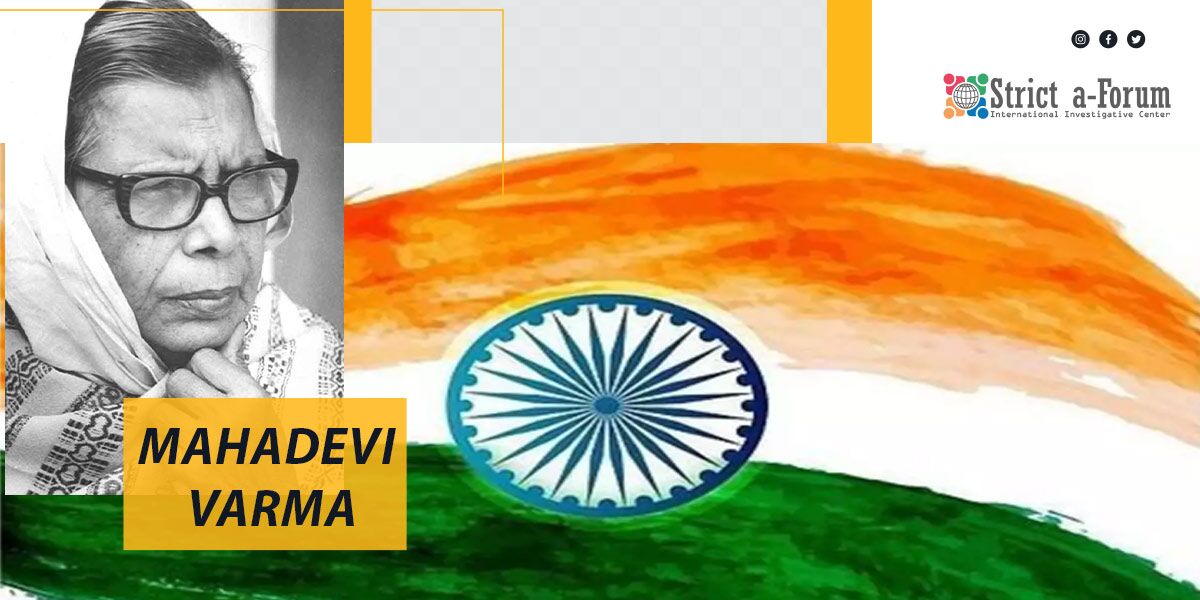
Married at the age of nine, according to the Hindu tradition, Mahadevi Varma, the poetess, writer, story teller and feminist, chose to spend her life without sexual activities, rejecting her father’s proposal to convert and have divorce.
Influenced by a number of writers and leader, among them Mahatma Gandhi, Mahadevi Varma served in empowering women in Indian villages through houses she built, like Meera temple, Umagarah, along with national struggle and literary activities.
Born in the 26th of March 1907, in Farrukhabad Indian city, an offspring of Kayastha family (caste of writers) and in a society that considers, at that time, females as a shame to her parents, Mahadevi was lucky with her ambitious grandfather who aimed at educating his granddaughter, under the condition of getting married at nine according the Hindu tradition. Her mother was a pious Hindu who loved music, while her father was an atheist professor who supported his daughter in her choices.
After being dismissed from a Convent school for her “mischievous” attitude, Varma took admission in Crosthwaite Girls College at Allahabad. She was always proud of the rich experience in such a school that accepts different castes, religions and cultures. At this school, Varma started her literary career as she wrote her poems encouraged by her colleague Subhadra Kumari Chauhan.[1] Both of the young poetesses sent their works to publications in various magazines. After her graduation, she refused to turn back to her husband, announcing that she does not want to get married by any means. First, she dedicated her life for educating women through her work as teacher and by means of public service.[2]
Her national strife for independence and exertions in women empowerment went along with her new literary production and contribution in developing Indian poetry, using every day dialects, reproducing soft vocabularies and ingenious images which made her one of the most important symbols in Indian literary life and one of the founders of the Indian Romantic movement “Chhayavad”.
Soon her volumes saw the light; in 1930 she published “Nihar”, in 1932 “Rashmi”, in 1933 “Neerja”, 1939 “Yama”, along with her 18 novels and short stories in which Mera Parivar (My Family), Smriti ki Rehaye (Lines of Memory), Patha ke Sathi (Path’s Companions), Srinkhala ke Kariye (Series of Links) and Atit ke Chalachrit (Past Movies) are prominent.
Mahadevi was appointed to lead Prayag Mahila Vidyapeeth in Allahabad, as she developed this college vastly a responsibility that was a considered a avant-garde step in the field of women’s education during that time. In 1923, she was the editor-in-chief of the women’s leading magazine “Chand”. Varma established the Literary Parliament in Allahabad and took up the editorship of its publication in the year 1955. She initiated women’s poets‘ conferences in India.
Varma was exceptionally outspoken, at her time, concerning women’s rights and conditions in Indian. In her book “The Wifehood of Hindu Women”, she declares that marriage system and tradition in India is closer to slavery system. Though she chose to live like a nun in her personal life, nevertheless, she was courageous in exposing female sexuality in her poems. She defied her society by exposing physical and mental abuse practiced against women. Her daring subjects were sweetly coated by her delicate and impressive usage of words and images.
Varma managed to face her society with the pains of women, guarding herself from its accusations and shaming through deserting sexual life, indulgence in resistance against colonialism and serving the poor. She was a talented painter and a gifted translator. Her self-built career kept her revered in her conservative society despite of her liberal opinions.[3]
In 1956 she was awarded with Padma Bhushan award, in 1982 she won Jnanpith Award, and in 1988 she was the laureate of Padma Vibhushan award.
On 11th of September 1987 she died at the age of eighty.
Following a sample of her poems:
Why An Introduction Dear
Why an introduction dear, you are within me,
reflections on starry nights, memories of a life,
creations of life in short spells, eyes notice
creations of life in short spells, eyes notice
gentle footsteps!
I don’t much to treasure anymore,
you are the treasure I have in me.
Your dazzling, radiant smile like sunrise
Is the reflection of fragrant sorrow,
it is consciousness, and dreamy slumber,
Let me tire and sleep incessantly, for
Would I understand the creation, big-bang! !
You are drawn, I am just an outline,
you are the sweet melody, I am just a string of notes,
you are limitless, I am but an illusion of limits,
In the secrecy of real image-reflection,
why enact to be lovers! ! !
Why an introduction, since you are within me.[4]
[1] https://www.dailypioneer.com/2022/state-editions/subhadra-kumari-chouhan—s-death-anniversary-on-feb-15.html
[2] https://www.britannica.com/biography/Mahadevi-Varma
[3] https://www.thefamouspeople.com/profiles/mahadevi-varma-10628.php
[4] https://www.poemhunter.com/poem/why-an-introduction-dear/