


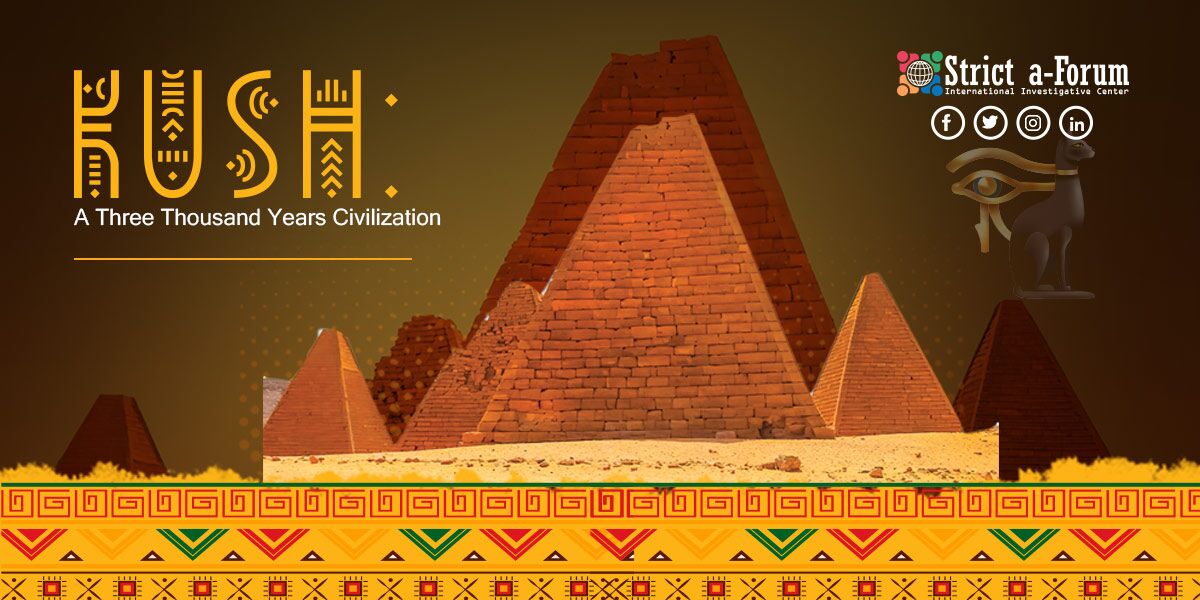
Located in the North of modern Sudan[1] and extreme south of Egypt, or what Egyptians call: Upper Egypt[2], Nubia[3], a nation that still exists with its language, customs, traditions and heritage, founded, three thousand years ago, a civilization that still has its impact on Nubians and on Egyptians in general.
The Nile Valley[4] produced several civilizations as it granted humanity: sweet water, rich soil and stability. In these, it resembles Euphrates[5] and Tigris.[6] About 5500 B.C., Badari culture[7], which is known today as Asyut[8], an Egyptian governorate, was the first to show human efforts in founding a civilization, as scientists discovered traces of a cultures demonstrating stable control of cultivation and animal farming, recognizable by its pottery and personal items, such as combs, bracelets, and beads. It was known for its high-quality ceramics, stone tools, exploiting copper.
These efforts were widespread in the region of Upper Egypt, and it had its influence on establishing variant civilizations throughout the Nile Valley. The Kerma culture[9] was an early civilization centered in Kerma, Sudan. It flourished from around 2500 BC to 1500 BC in ancient Nubia. The Kerma culture was grounded in southern Nubia, or „Upper Nubia“ (in parts of present-day northern and central Sudan), and later protracted its reach northward into Lower Nubia and the border of Egypt.
The Kerma culture was the first foundation for Kush Kingdom. The earliest historical reference to Kush, was recorded in the ancient Egyptian records as Mentuhotep II[10], is recorded to have commenced military operations against Kush in the 29th and 31st years of his reign. Under Thutmose I[11], Egypt made several campaigns south.
Nubia was captivated into the New Kingdom of Egypt, but revolts continued for centuries. After the subjugation, Kerma culture was gradually Egyptianized, yet uprisings continued for 220 years until 1300 BC. Nubia became a crucial domain of the New Kingdom, economically, politically, and spiritually. Major ancient Egyptian ceremonies were held at Jebel Barkal[12] near Napata[13].
However, Nubia was separated from the New Kingdom of Egypt, eventually after the latter’s decay. In 1070 B.C., Kingdom of Kush was established, nevertheless, it was too Egyptianized, hence, it could be regarded as part of the Egyptian history.
Alara,[14] first founder of the Nubian Kingdom known as Kush kingdom in Napata in the eighth century B.C., unified all of Upper Nubia from Meroe[15] to the Third Cataract[16], establishing the Temple of Amun at Kawa[17]. He is highly esteemed in the Nubian history.
The Kush, exploiting the deterioration of the Egyptian Kingdom, invaded Egypt between 728 B.C. to 716 and ruled it for about a century until the Assyrian invasion to Egypt 674 B.C.
The Kush people were rebellious and rejected the subjugation to any power that ruled Egypt later. It was not until the Mamlouki reign that Nubia was considered an Egyptian province again.
It is hard to differentiate between the Nubian religion and mythology from the Egyptian ones.
Like the Egyptian language, the Nubian languages[18] with its branches belong to the Afro-Asiatic languages.
[1] https://www.cia.gov/the-world-factbook/countries/sudan/
[2] https://www.britannica.com/place/Upper-Egypt
[3] https://www.britannica.com/place/Nubia
[4] https://www.cleopatraegypttours.com/travel-guide/around-cairo-attractions/nile-valley/
[5] https://www.biblestudytools.com/dictionary/euphrates/
[6] https://www.nationalgeographic.org/encyclopedia/tigris-river/
[7] https://www.britannica.com/topic/Badarian-culture
[8] https://www.britannica.com/place/Asyut-governorate-Egypt
[9] https://oi.uchicago.edu/museum-exhibits/nubia/kerma-culture
[10] https://www.britannica.com/biography/Mentuhotep-II
[11] https://www.britannica.com/biography/Thutmose-I
[12] https://www.atlasobscura.com/places/jebel-barkal
[13] https://www.britannica.com/place/Napata
[14] https://www.britannica.com/biography/Alara
[15] https://www.britannica.com/place/Meroe
[16] https://www.tripadvisor.com/Attraction_Review-g2034069-d8141033-Reviews-Third_Cataract_of_the_Nile-Dongola_Northern_State.html


