


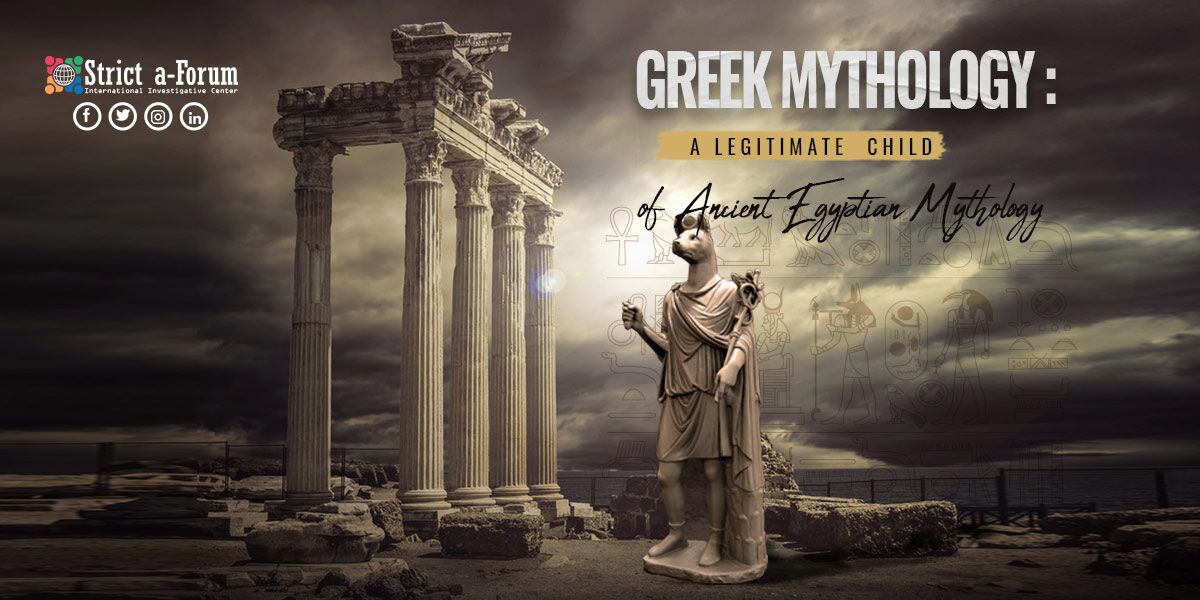
Creation myths are a part of all cultures worldwide. They are the method to interpret natural phenomena, where a people came from and how their civilization established. The word mythology[1] is driven from the Greek word “mythos” which means: the story of the people.
Myths are often based on sacred fables, relating the story of a group of people.
Ancient Greek[2] civilization benefited from all civilizations it encountered. We can trace this impact in the Greek sciences, philosophy, social system, legal system, governance, etc, however, ancient Greece had always its documented mythology though we can trace some Egyptian and Persian influence. While being occupied by Persians[3], between the years 499 B.C. to 449 B.C., the ancient historian and geographer “Herodotus”[4] travelled throughout the world, he started with Egypt to get his education, he traveled in Egypt in Athenians’ company, around the year 454 BC or earlier, after an Athenian navy had abetted the Egyptian revolution against Darius[5] rule in 460–454 BC.
The Ionian city, in 499 BC, revolted against their Persian rulers. Reinforced by herds sent from Athens and Eretria, they progressed as far as Sardis[6] and burnt the city before being defeated by a Persian revenge. The rebellion continued until 494, when the protesting Ionians were beaten. Darius did not overlook that Athens had supported the Ionian revolution, and in 490 he gathered a fleet to avenge. Though severely outstripped, the Athenians—aided by their Plataean partners—overpowered the Persian throngs at the Battle of Marathon, and the Persian navy met its end.
Meanwhile, the ambitious researcher “Herodotus”, went on collecting all essential information, thoughts, civilization aspects to his own nation, through; learning in Egypt, from Persians, visiting Africa, Asia and grasping variant cultures.
Such deep encountering with multiple civilizations gave birth to the great Greek civilization which, one day, ruled the world, starting from the invasions of Alexander the Great (20/21 July 356 BC – 10/11 June 323 BC) who founded the glory of his nation.
Mythology:
Nevertheless, the Greek mythology is much older than the abovementioned dates. “Theogony”[7], composed c. 730–700 BC, by Hesiod[8], stipulates most of the ancient Greek mythology. The word “Theogony” means “the genealogy or birth of the gods”. The long epic states that the universe commenced with the unprompted cohort of four beings: first caused Chaos (Chasm); then Gaia (Earth), „the basis of all“; „vague“ Tartarus, in the depths of the Earth; and Eros (Desire) „most beautiful among the eternal gods“. From Chaos came Erebus (Darkness) and Nyx (Night). And Nyx „from unification in love“ with Erebus produced Aether (Brightness) and Hemera (Day). From Gaia came Uranus (Sky), the Ourea (Mountains), and Pontus (Sea).
Bearing in mind that his epic “Work and Days”[9], composed around 700 B.C., was based on Egyptian, Sumerian and Hebrew philosophy, we can also relate some Greek gods with other deities; as Chasm goes for “Seth”[10], Gaia is equivalent to “Isis”[11] in Egypt or “Nammu”[12] in Sumerian heritage.
This marriage between civilizations created one of the most powerful and influential civilizations which is still impacting human mind till this moment.
#Greeks #Egypt #Sumari #Persians #History #Mythology
[2] https://www.worldhistory.org/greece/
[3] https://education.nationalgeographic.org/resource/persian-empire
[4] https://www.history.com/topics/ancient-history/herodotus
[5] https://www.thecollector.com/darius-the-great-king-of-kings/
[6] https://www.worldhistory.org/sardis/
[7] https://www.worldhistory.org/Theogony/
[8] https://www.britannica.com/biography/Hesiod
[9] https://www.theoi.com/Text/HesiodWorksDays.html
[10] https://egyptianmuseum.org/deities-seth
[11] https://www.britannica.com/topic/Isis-Egyptian-goddess
[12] https://www.ancient-origins.net/myths-legends-europe/nammu-forgotten-tale-sumerian-mother-gods-0010041


