


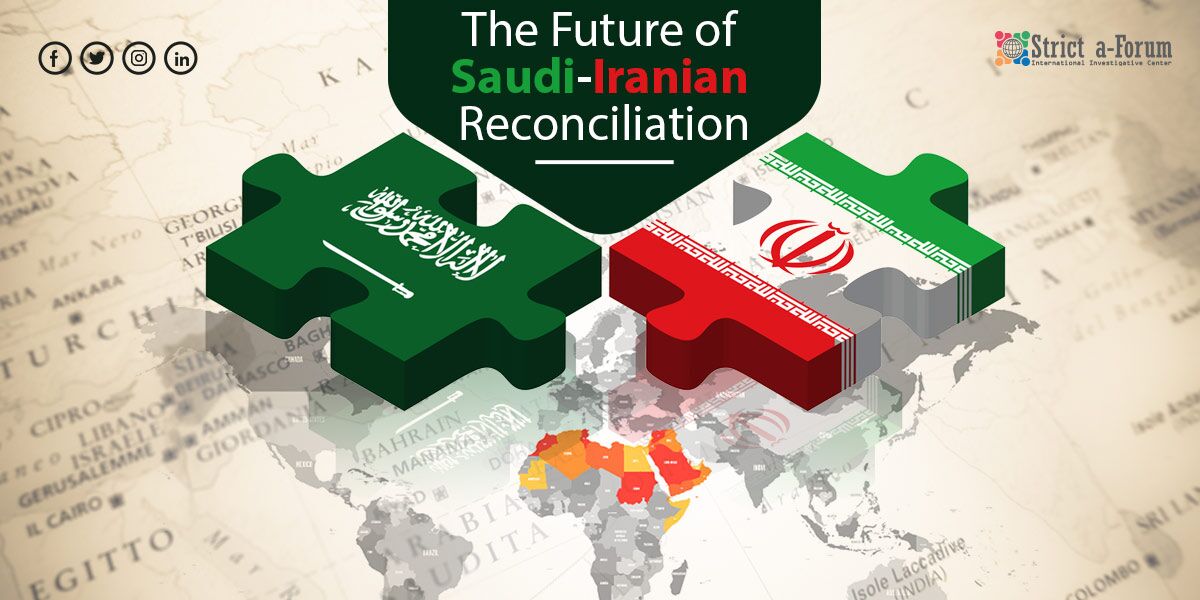
The meeting between the Saudi foreign minister and his Iranian counterpart, hosted by the Chinese capital, Beijing, is a positive step in an unexpected path towards the return of stability that the region has been lacking for more than 40 years.
This meeting came less than a month after the Saudi-Iranian agreement, which was announced under Chinese auspices on March 10, as its timing also testifies to the Chinese competence, and the determination of both parties to move forward with this agreement until it reaches its conclusions.
The choice of both Saudi Arabia and Iran for their foreign ministers to preside over the meeting that took place on Thursday reflects the confidence of both leaderships in the deal that was reached, and thus the relevant government bodies were authorized to activate the content of the agreement. Hence, it was important for Ali Shamkhani, a two-star general and secretary of the Iranian Supreme National Security Council, to attend the signing of the preliminary agreement, as well as Musaed Al-Aiban, a high-ranking advisor at the Saudi Royal Court and trusted aide to the crown prince.
I expect that the selection of these two people to participate in the signing ceremony of the agreement came based on the Kingdom’s insistence on refuting the allegations of critics who question the Iranian-Saudi agreement. Claims were, that the agreement may have had the blessing of the Iranian Ministry of Foreign Affairs, but not the blessing of the actual ruling powers in Iran or its security services. Thus, Tehran will not be able to claim that the aforementioned agreement was not supported by everyone in the regime. (Note that no one believes that there is a real separation of powers in Tehran, but it is an argument that has long been invoked.)
I have been asked many times over the past month how seriously the Iranian regime is committed to the agreement. No one has the answer to this question, except the senior officials in Tehran. What I know, and what any experienced negotiator knows, is that it doesn’t take much for such an agreement to collapse.
Iranian negotiators are said to have the patience of a Persian carpet weaver. Whether they are negotiating with Saudi Arabia or with Western countries – playing for time has always been their trump card. In the Saudi case, they took advantage of the fact that all Saudi kings were of an advanced age when they ascended the throne, so the Iranians knew that it was only a matter of time before they had to deal with a new leadership whose priority would be first to organize the internal affairs of its country before it went into conflict with Iran.
When dealing with Western democracies, Iran has realized that elected leaders change every few years. Even recently, with the official transfer of power from Trump to Biden in the White House, all Tehran had to do was overcome the „maximum pressure“ campaign that Trump waged on the Iranian regimeWith Biden in power, reviving the Iran nuclear deal was on the agenda, which meant the Iranians could again demand concessions.
The good news is that the agreement which was signed on March 10 with Chinese mediation did not take into account any of the previous considerations. What makes it different is that it is based on a „double guarantor”: Crown Prince Mohammed bin Salman on the one hand, and China on the other.
The rule of the Crown Prince, who is young, dynamic and capable, is characterized by internal stability and continuity of foreign policy for decades to come, which enables the concerned officials to focus on all the details of the deal until reaching its conclusions. On the other hand, the agreement was brokered by China and not by the United States, so it will be difficult for Tehran to evade it, citing the US administration, which may not have bipartisan support in Congress, and will be replaced after serving its term.
China succeeded for the first time, through its sponsorship of this agreement, in appearing as a peacemaker on the world map, not to mention enhancing the respect it enjoys as a global superpower. China has pledged to invest $300 billion in Iran over 25 years as its largest trading partner, so there is no doubt that the Chinese dragon will spare no effort and will remain on Tehran’s heels to ensure its commitment to the deal. In my opinion, this is the only way to make the deal work.
Does this mean that success is guaranteed? Well, nothing is guaranteed in politics. But there are three possible scenarios.
The most pessimistic scenario is that Iran will not abide by the agreement. With Iran’s retreat from the agreement, we will have missed a great opportunity to achieve peace in the region. By backing away from the agreement, Tehran would also have turned against a country the size and weight of China, especially since Iran has only two befriended countries on the world stage, one of which is China, and the other is Russia, which is currently preoccupied with its own problems. For Saudi Arabia, Iran’s reversal of the deal simply means a return to the status quo, as it has more than 40 years of experience in confronting Iran’s destabilizing activities and standing up to its militias.
The most likely and realistic scenario is for the deal to advance slowly, but steadily, as the agreement already stipulates that both countries commit to cease attacks and not support hostilities against each other. In this context, the Iran-backed Houthi militia in Yemen announced on Thursday the extension of the truce in the country for a period of six months, which is a positive sign. The two countries also agreed to reopen diplomatic missions, which would enable the two regional powers to negotiate directly and use diplomatic means to help the concerned governments achieve stability and come up with the best possible solutions in trouble spots such as Yemen, Lebanon, Iraq and Syria.
The most optimistic scenario is that we all wake up one day to find that every regional conflict bearing Iranian hallmarks has been resolved, including Tehran’s withdrawal from Iraq, Lebanon and Syria. However, this is unlikely given the large amount of Iranian investments and interests entrenched in these countries.
Regardless of the different scenarios and their outcomes, however, the agreement reached represents a clear victory from the Saudi perspective, not only for the Kingdom but also for the region, global markets, and energy security.


