On the banks of “Tigris” and “Euphrates”, one of the first civilizations on earth emerged. Usually, civilizations are founded by militaries, yet buoyed by priests who give legitimacy to the triumphant who wants to be a king; a proprietor to a region and a master to the population yonder. Notwithstanding, the Sumer civilization was initiated on the shoulders of priests, later on, militaries took over, but they kept priests alongside to bestow them blessings of the deities and obedience of the people.[1]
According to the biblical narrative, Abraham, the “father” of the three main religions: Judaism, Christianity and Islam, originated from Mesopotamia. Thus, it is motivating to listen to the “pagan” account; the “Enuma Elish”[2] regarding the cosmic births.
Creation:
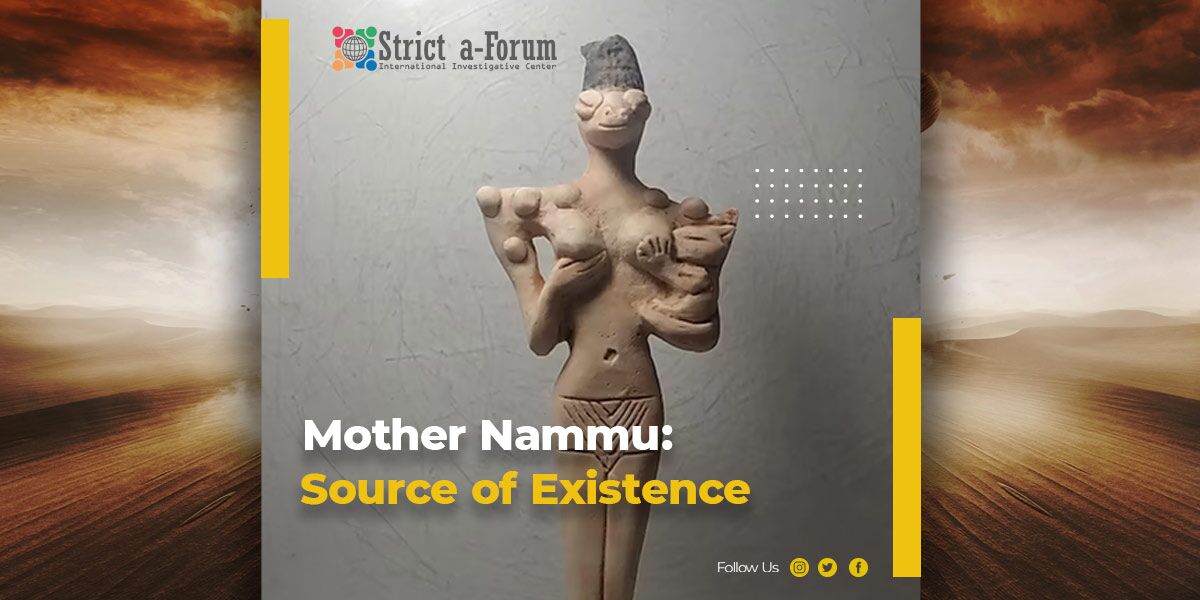
It was all dark, it was all water, Mother Nammu, (corresponding to Tiamat) goddess of primordial sea, mated with Abzu, also called Engur, god of aquifers, and they gave birth to “Anshar” (all fathers/ whole heaven) and Kishar (all mothers/ whole earth). Subsequently, the two children coupled to give birth to An (god of the sky) and Ki (goddess of earth).[3] Enki,[4] another son of Mother Nammu, a god of water, knowledge, craft, and creation, and a symbol that is connected to the Abrahamic religions, notably Judaism, is the one who created human beings.
The sky and earth gave birth to Enlil, god of wind, earth and storms, he unglued his parents; the sky and earth, then he subjugated the earth. Creatures are under the deities’ maintenance and their generosity in a land that is deprived of rain because of its hot weather, nevertheless, is blessed with two abundant rivers that the inhabitants were clueless of their springs. They always believed that gods are settled in heaven. When humans die, they go to the underworld, “Kur”, a dark, cold, frightening place, ruled by goddess Ereshkigal.[5]
The Sumer tradition imagined the world as a closed dome, there is water underground and under water there is the “Kur”.
Afterlife:
Unlike the Egyptian mythology which stipulates that people are rewarded for their good deeds and punished for their evil actions, the Sumer mythology believed that no matter how good or evil an individual was, s/he is destined to the same fate in “Kur”, in which no food except dry dust. Hence, the family of the deceased used to pour water and grains on his/her grave; a custom that is still practiced in the middle east. Those who had no families and of springs would suffer in the underworld, because nobody would provide them with water and food. Therefore, a pregnant woman was a sacred creature because she was the guarantee of having a good life after death.
Having sons and daughters was not the only way to be well treated in the afterlife, “bribing” gods by burying food and rich stuff with the deceased and giving the dead sumptuous burials was a way to seek good treatment in the “Kur”.
Sources:
The Sumer tradition was inherited orally through priests, then it was depicted through architecture around 2500 years before Christ and finally it was portrayed in Epic of Gilgamesh around 2100 B.C.[6]
Abrahamic Religions:
Similar to the ancient Egyptian religion, the Sumer religion has many common features with the dominant Abrahamic religions: Judaism, Christianity and Islam; the ideas of the wholeness of the universe, water as a source of life, the underworld, the afterlife, moreover, some ethical principles which resembled the Jewish law and Islamic Sharia.[7]
Myths and scientific theories:
Though science deals with facts, it is stimulating to view myths in context of scientific evaluation. Myths depend on phantasm, while science depends on certainties, however, human imagination had envisioned some realities and expressed it exploiting symbolism.
[1] https://www.worldhistory.org/sumer/
[2] https://www.worldhistory.org/article/225/enuma-elish—the-babylonian-epic-of-creation—fu/
[3] https://archive.org/details/artoffirstcities0000unse
[4] https://www.jstor.org/stable/3296569
[5] https://www.worldhistory.org/article/701/ancient-mesopotamian-beliefs-in-the-afterlife/
[6] https://www.sparknotes.com/lit/gilgamesh%5d/summary/
[7] https://ancientworldsnews.com/the-idea-of-religion-in-sumerian-civilization/#:~:text=All%20the%20Abrahamic%20religions%2C%20like%20Judaism%2C%20Christianity%2C%20and,humans%20have%20always%20had.%20How%20did%20life%20start%3F