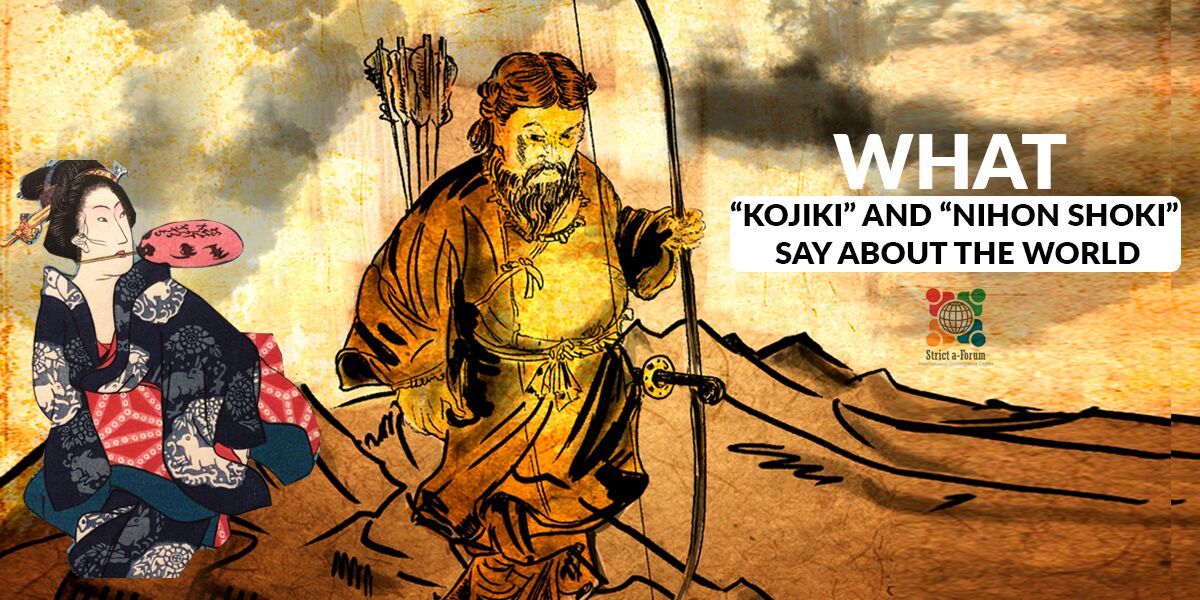
The Japanese archipelago, through its isolation, served humanity with sophisticated mythology since the prehistorical era. This heritage was documented in “Kojiki”[1] 712 A. D. and “Nihon Shoki”[2] 720 A. D., as both collected all accessible oral heritage of Japan.[3]
Archaeologists divide the prehistoric history of Japan into three eras based on qualities of the findings connected to each epoch. The Jōmun[4] era, starting 1400 B.C., shows the first discoveries of pottery found on the archipelago, followed by the Yayoi[5] epoch, from 300 B.C. to 300 A.D. and the Kofun[6] period, from 300 A.D. to 538 A. D.
Compared to eastern civilizations, like Egypt, Iraq, India and even China, this is a “recent” civilization. Being so “young”, in contrast to stated civilizations, and though geographically isolated, the archipelago was able to clutch the ancient wisdom and reform it to a very peculiar model that conform with its distinct and remote society.
Origin of the World
Izanagi[7], is the creator of Japan. He and his sister-wife Izanami[8] are the last of the seven generations of primeval divinities that demonstrated after the creation of ecstasy and earth. They both created the Japanese archipelago and they are the ancestors of many gods, including the sun goddess Amaterasu[9], the moon god Tsukuyomi[10] and Susanoo[11] the storm god.
A narrative that is parallel to most narratives worldwide, including the very distant one: the Americas. However, the Hindu account is more abstract and symbolic.
The Japanese civilization did not pass through the “maternity” phase like its ancestors in other regions. It is considered to adopt masculinism[12]. According to the myth, Izanagi and Izanami had their union ceremony, then they mated. Their first child was deformed as he was born without limbs or bones. With agony, the two deities asked the greater gods about the cause of giving birth to such a child. The gods answered that during the ceremony Izanami talked before Izanagi, which brought them curse, as a male should lead a female.
Once they obeyed the instructions and the woman revered the man as it is supposed to be, they gave birth to multiple children after which the Japanese islands were named.
The Underworld
Yomi,[13] the land of the dead. Izanami dies, her loving husband and brother tries to save her. He goes into the Yomi, as he meets strange and dangerous things. He uses all guiles to deceive the guards. After locating her he talks to her while she is hiding. She promises him to get a authorization to leave Yomi. He asks to come to his sight as he misses her, she tells him that this is impossible right now, they will meet later; moreover, she asks him not to try to look at her while she moves to get the permission. Once she moves, he peeps at her; he is astonished and disgusted of her new rotten appearance, he leaves her and escapes.
Feeling betrayed, Izanami chases him to capture her abandoning husband, but she fails as he uses the peach to hinder her.
After returning from Yomi, Izanagi goes to a ceremony of purification, as purification and cleansing is a deep-rooted ceremony in the Japanese tradition till now. When he is washing, many deities are created from the water coming from his bath: Amaterasu, the Sun goddess and divine ancestor of the first Emperor Jimmu[14], the Moon god and Susanoo the storm god all are born at the same time when Izanagi washes his face.
Unlike most of mythologies which stipulate that it was first the water, then the world, the Japanese mythology states that it was first the “oil”, then the world.
Shintoism,[15] which first emerged in Japan, with its countless gods, is still practiced in Japan till now, along with Buddhism. Notwithstanding, there is a third path in which Shintoism is mingled with Buddhism.
Geographical Impact
Being secluded, a sense of fearing strangers was cultivated. Hence, a zealous fighter is highly esteemed. Therefore, myths about human heroes with their miracles were widespread in the archipelago, some of them were related to certain islands, others were famous in all the archipelago like the courageous peach boy Momotarō.[16]
But there are other myths about heroes of charity and kindness, like Shita-kiri Suzume.[17]
The stories of these heroes are meant to give moral lessons.
As Japan is one of the developed countries, it is keen and successful in guarding its heritage.
[1] https://www.worldhistory.org/Kojiki/
[2] https://jhti.berkeley.edu/Nihon%20shoki.html
[3] https://www.japan.travel/japan-heritage/
[4] https://slife.org/japanese-mythology/
[5] https://www.merriam-webster.com/dictionary/yayoi
[6] https://www.worldhistory.org/Kofun/
[7] https://mythus.fandom.com/wiki/Izanagi
[8] https://naruto.fandom.com/wiki/Izanami
[9] https://naruto.fandom.com/wiki/Amaterasu
[10] https://naruto.fandom.com/wiki/Tsukuyomi
[11] https://naruto.fandom.com/wiki/Susanoo
[12] https://www.sciencedirect.com/topics/social-sciences/masculinism
[13] https://www.worldhistory.org/Yomi/
[14] https://www.britannica.com/topic/Jimmu
[15] https://worldreligions.wordpress.ncsu.edu/shintoism/
[16] https://mythus.fandom.com/wiki/Momotar%C5%8D
[17] https://fppspiritfables.wordpress.com/shita-kiri-suzume/