


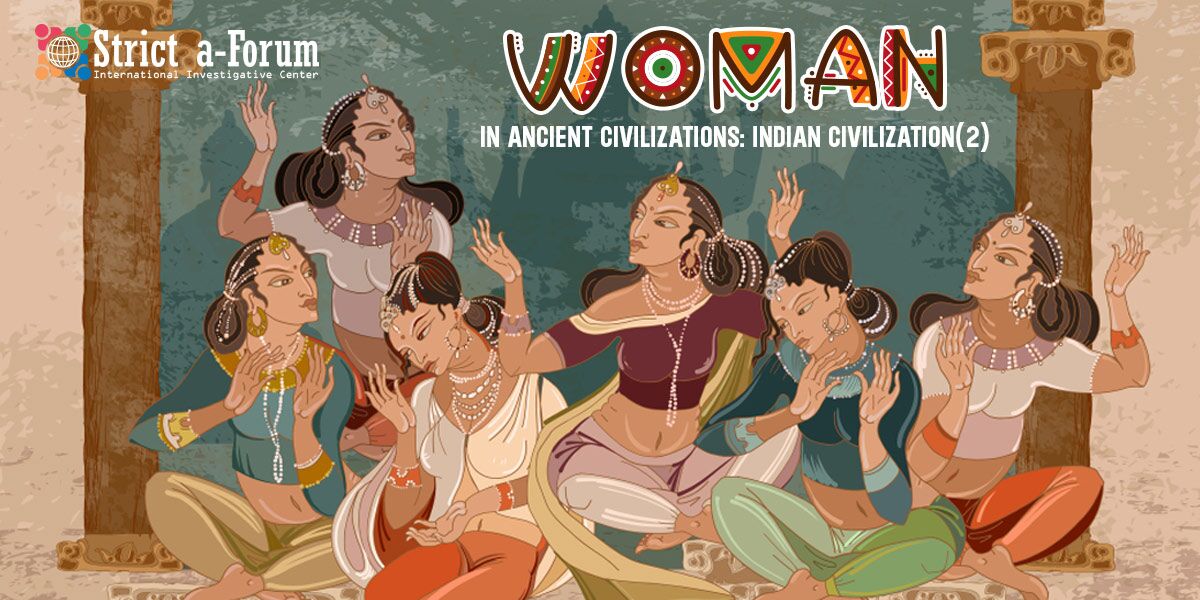
The position of the Indian woman in the ancient Indian civilization fluctuated between reverence and exploitation. It is interesting that in the immemorial times of Indian civilization, women enjoyed a better and more sacred position than in later times. Today we review the status of women in ancient Indian civilization and the evolution of their status through times.
Indian civilization was associated with a group of religions, namely Brahmanism, Hinduism, and Buddhism, and some of these religions gave women a high status, and some gave them an inferior status.
The Vedic[1] religion gave women a prominent position, but with the development in India and the increase in priests and their control, they changed the status of women to an inferior position. Vedic and Brahmanism are considered the first names of Hinduism, and the name Vedic is still the name of the holy book of Hinduism. Brahma is considered the main god of the Hindu religion, nevertheless Hinduism is not the main religion in India, but it is considered the history and civilization of India. Through this religion we see the development of the position of women in Indian society.[2]
In the early Vedic period, there were a large number of deities bearing respect for women. Ardhanareeshwar, was half man and half woman and was the idol of Indians. Women in Vedic society participated in religious ceremonies and tribal gatherings (Sabha and Vedas). There is no evidence that women were deprived from domestic and social affairs.[3]
Women were allowed to have multiple husbands and could divorce themselves from their husbands. Widows could remarry and child marriage was not common.
Women at that time also enjoyed the right to choose a husband through a ritual known as Swayamvara, where men gather to introduce themselves to women, and each woman chooses the right husband for her. She had the right to choose multiple men, they either rival to gain her love or accept to share her love together. There is historical evidence that women had a share in government, even if it was indirect, and that they participated in political and even military decision-making.[4]
In the later Vedic period, the status of women gradually began to deteriorate. This period clearly witnesses the increasing inclination to divide society into classes on the basis of gender. Women gradually began to lose their political rights to attend meetings. Child marriage also began to appear. The daughter was described as the source of misery.
The sati system emerged as a formal custom during the somewhat later Vedic period. Previously, it was customary for the widow to symbolically lie next to her husband’s body in the funeral pyre, but the woman began to be burned alive with her husband during this period.
Marriage or home life became compulsory for the woman and total devotion to the husband was her sole duty.
There are indications of the influence of the mother in society.
Women witnessed the worst social position during Mauryan[5] period. It was the age in which exploitation of women and polygamy flourished. However, they still occupied a number of important positions like guards and councilors or the king.
In the period of dominance of Buddhist rule, although the position of women was not the best at all, it was relatively better than in later periods. During this period, the idea of women’s equality in property began to appear. However, it was imposed on women, especially from the upper classes, to wear the veil. However, this custom was not widespread among the general public.
After the end of Buddhist control, the status of women again deteriorated further. Widows were prevented from marrying after their husbands‘ death, and they had to cut their hair, get rid of all their jewelry and eat simple food. This behavior towards widows was taken from the northern emirates, and then began to spread to the south.[6]
The status of women continued to deteriorate, until they had a major role in resisting the British occupation. With the increasing role of Indian women in the resistance, they began to impose themselves on the scene[7], and again demanded their rights based on their active participation in the liberation of their country, and according to their ancient heritage, which gave them rights that amounted to their sanctification.[8]
[1] https://www.britannica.com/topic/Vedic-religion
[2] https://www.grunge.com/231367/what-life-was-like-for-women-in-ancient-india/
[3] https://www.iloveindia.com/history/ancient-india/women.html
[4] https://www.jstor.org/stable/1177740
[5] https://education.nationalgeographic.org/resource/mauryan-empire
[6] https://www.thisismyindia.com/ancient_india/woman-in-ancient-india.html
[7] https://www.yourarticlelibrary.com/women/status-of-women-in-ancient-india/47636
[8] https://academic-master.com/history-of-the-culture-of-indian-women/


