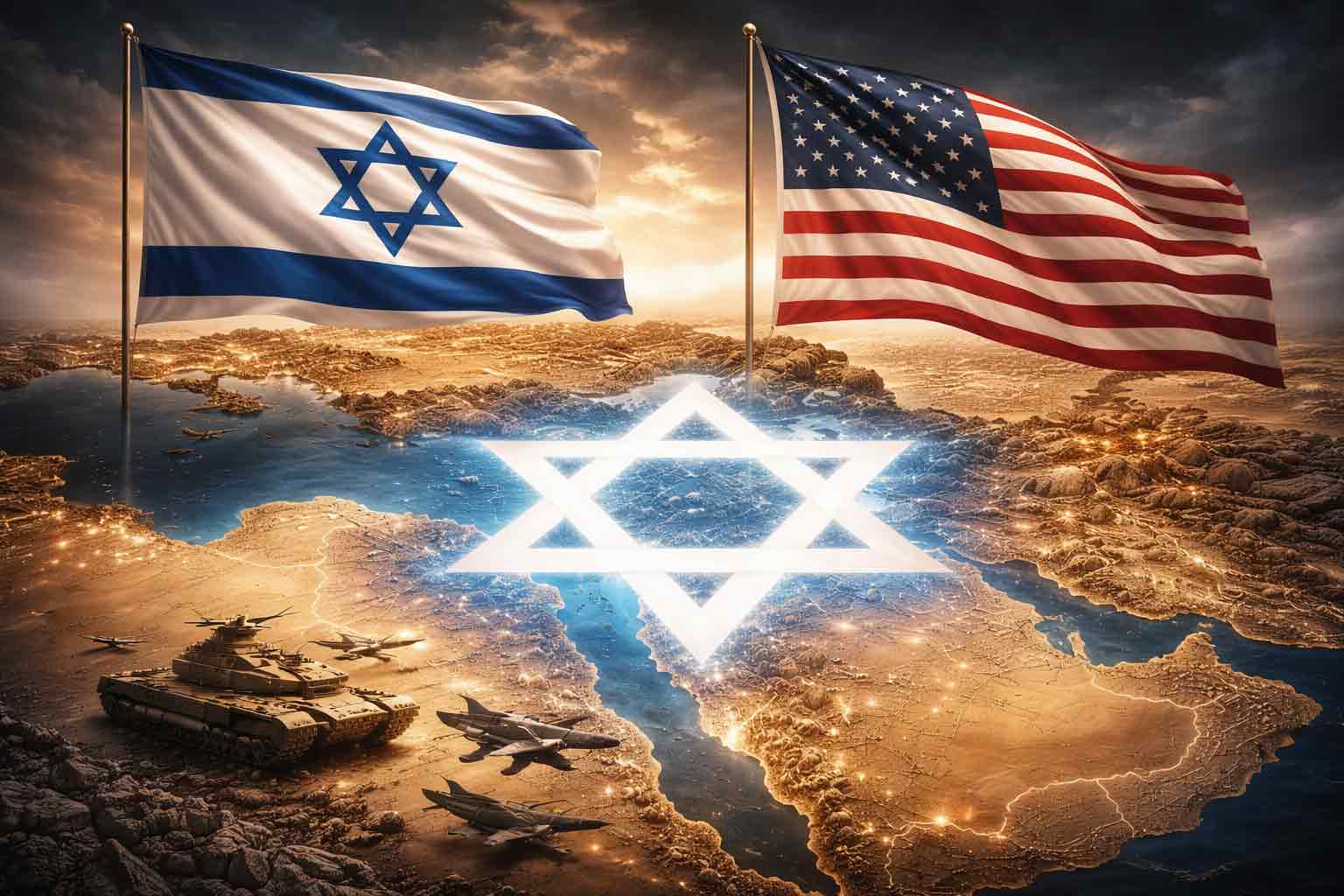
Huckabee Middle East remarks
The United States and the Logic of Impunity
Huckabee’s Words and the Fragility of International Order
When U.S. Ambassador to Israel Mike Huckabee told conservative commentator Tucker Carlson that it would be “fine” if Israel controlled territory stretching from the Nile to the Euphrates, Washington moved quickly to characterize the statement as “hyperbolic.”
But some remarks, even when dismissed as exaggerations, expose deeper assumptions. Huckabee’s comment was not merely rhetorical excess. It was revealing.
The reaction across the region was immediate and unusually unified. Foreign ministries from 14 Arab and Islamic countries — including Egypt, Jordan, Saudi Arabia, Qatar, Turkey, and Palestine — issued a joint condemnation. The Gulf Cooperation Council, the Arab League, and the Organisation of Islamic Cooperation echoed similar concerns, warning that such statements undermine regional stability and contravene international law and the UN Charter.
Jordan was particularly direct, calling the remarks “irresponsible, escalatory and absurd,” and describing them as a breach of diplomatic norms and a violation of international law.
Their response was not political theater. It was grounded in legal reality.
The Legal Framework Huckabee Overlooks
International law does not recognize theological geography. Whatever religious narratives may exist, the modern international system rests on defined borders, sovereignty, and the prohibition of acquiring territory by force.
In 2024, the International Court of Justice concluded that Israel’s occupation of Palestinian territories is unlawful and must end. UN Security Council Resolution 242 — adopted after the 1967 war — established a foundational principle: territory cannot be acquired through war.
The Palestinian right to self-determination is not a matter of ideology. It is codified in international law, repeatedly affirmed by the UN General Assembly and supported by the overwhelming majority of the international community. The demand for an independent Palestinian state in the West Bank and Gaza, with East Jerusalem as its capital, reflects a longstanding diplomatic consensus — not a radical position.
Huckabee’s refusal to recognize Palestinians as a legitimate national identity moves beyond theological interpretation. It challenges the existence of a people whose political status has been the subject of decades of international diplomacy. Such a stance places him outside the framework that governs modern state relations.
Predictable — Yet Still Consequential
Huckabee’s views are not new. As a self-identified Christian Zionist, he has long rejected the two-state solution. His appointment as ambassador did not signal neutrality. Observers familiar with his record were not surprised.
What is new is the openness with which such views are now articulated by a sitting ambassador.
Diplomacy depends not only on policy, but on restraint. Even informal remarks by senior officials shape perceptions. When an ambassador suggests that regional conquest would be acceptable, even hypothetically, it normalizes expansionist logic and weakens the norms that protect vulnerable states.
Several governments have called on Washington to clarify its official position. That request is reasonable. Yet credibility erodes when the gap between stated policy and rhetorical signals widens.
Palestine and the Limits of Negotiation
For decades, the Palestinian question has been managed through delay, deferral, and procedural diplomacy. But one principle has remained constant: occupation is temporary under international law. Permanent annexation is not.
The right of return, the right to statehood, and the right to end military occupation are not maximalist slogans. They are legal claims grounded in established international norms.
No theological argument alters that framework. No ideological conviction supersedes the prohibition against acquiring land by force.
Huckabee’s remarks were later softened as “somewhat hyperbolic.” But the deeper issue is not whether the statement was literal. It is that such thinking is increasingly visible within corridors of power.
The concern, therefore, is structural. When international law becomes negotiable in rhetoric, it becomes fragile in practice.
The near-unanimous condemnation from Arab states reflects an understanding of that risk. The issue is not merely Palestinian statehood. It is the credibility of the international order itself.
And once that credibility erodes, it is not easily restored.