


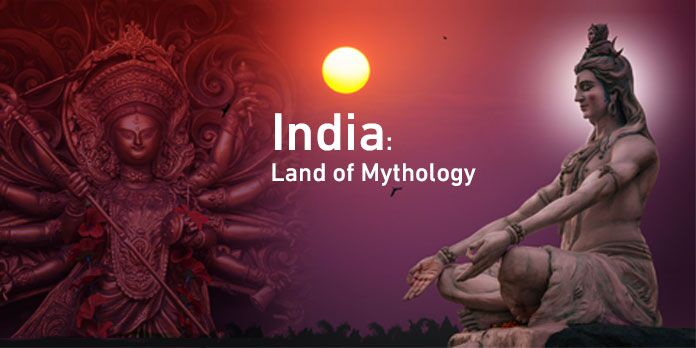
India: Land of Mythology
By: Nawara Negm
It is intolerable to talk about mythology without citing India. The land of ancient civilizations; a scenery that endured different beliefs and elucidations of the cosmic. From this landscape, multiple religions and mythologies emerged and coexisted peacefully most of the times, yet, conflicting in sometimes.
History:
Early modern humans arrived from Africa to the subcontinent 73 thousand years ago.[1] They started their agricultural age 7000 B.C and founded their first civilization, the Indus Valley Civilization, 4500 B.C.[2] which flourished 2500 B.C. in the area which is known now as Pakistan.
A drought led to the diaspora of the Indo-Aryan tribes, forming the Vedic age. It was first when we find the Vedas; a collection of religious hymns dated 1500 – 500 B.C. composed in Vedic Sanskrit language; an ancient language belongs to the Indo- European languages group.[3]
Through these Vedas, from which we discover language; a brooder that expresses and conducts beliefs, we determine the basis of Hinduism; the first religion founded in India. We know now about the Varna system,[4] which developed to be the caste system.[5]
India is all about caste; the religious, social, economical and political body which formed the very distinguished features of the Indian ancient and modern character.
Varna, or caste, is a hierarchy of priests, warriors, and free peasants. This hierarchy is the seed from which marriage system sprung.
The female status in this system puzzled the Europeans when they first came to India. Females are not totally emancipated, notwithstanding, they do not reflect the medieval European concept of “Virtue”.
When the European missionaries first came to India, they stigmatized the Indian society in general and the Indian female in particular; describing them as morally decadent.[6]
Before the arrival of the Europeans, India had had evolved and received diverse religions other than Hinduism; Buddhism, Jainism, Judaism, Christianity, Islam, Zoroastrianism, Sikhism…etc. A good part of these religions chiefly originated from Hinduism, trying to find a solution for the injustice caused by the caste system,[7] others just came through trade, like Islam, or through seeking religious refuge like Jews who escaped the captivity of Babylonia and Christians who fled the Arab conquest to Syria. However, the version of the Abrahamic religions in India used to be affected by the dominant culture in the society, hence, it is comprehensible that European missionaries when first came to India did not consider Indian Christianity of Saint Thomas a “correct” version of the “real” Christianity. Therefore, they forced Indian Christians of Saint Thomas to relinquish their heritage and espouse the European Christianity.[8]
This lenient environment soon changed after the entrance of Europeans who targeted primarily Muslims as their principal foe and foremost barricade before converting Indians; and they were; as Muslims felt endangered by the appearance of their historical religious rival.
Though, no Abrahamic religion won this battle.
We will start by displaying the philosophy of the founding doctrine and the third largest religion worldwide: Hinduism.
Hinduism and Mythology:
An extremely complicated body of myths, ideas, philosophies and rituals. To its devotees, Hinduism is a traditional way of life. Numerous believers refer to the „orthodox“ system of Hinduism as Sanātana Dharma,[9] „the eternal law“ or the „eternal way“. Hindus regard Hinduism to be thousands of years old. The Puranic chronology[10], the timeline of events in ancient Indian history as related in the Mahabaratha, the Ramayana, and the Puranas, envisages a chronology of proceedings associated to Hinduism commencing before 3000 B.C.
This active collective mind forming Hinduism abided all explanations of cosmology; there is no single story to describe the creation. Hinduism displays a diversity of contradicting theories rather than providing a narrative about how the world was formed.
Some Hindu manuscripts, like the Rig Veda,[11] stipulate the Hiranyagarbha („hiranya = golden or radiant“ and „garbha = filled / womb“) that existed before the creation, as the source of the creation of the Universe. However, Hindu priests refer to this story as a “metaphor” to the essence of the universe.[12]
Another story about Purusha, who is supposed to be the father of humans, yet, we find out that Hindus evaluates his story in an abstract and symbolic manner.[13] He is not “The father”, like Adam or Osiris, he is an allegory symbolizing the cosmic self.
It is interesting to know that Hinduism regards the deities as “creatures”, stipulating in the Nasadiya Sukta[14] that nobody knows the source of this universe, and that gods nothing but symbols.
Spiritualities:
Being so contemplating about the universe, Hinduism implemented an analytical point of view concerning the Human Nature.
There are certain aspects in human nature that should be fulfilled: Dharma (ethics), Artha (livelihood), Kama (sensual pleasure), Moksa (freedom). An individual should achieve balance between all these facets.
Another universal concept dominates the Hindu consciousness; Karma, that is to say: you gain from the universe what you give it.
Modern Impact:
The universality and philosophical slant of Hinduism allowed it to influence non-Hindus worldwide even non-believers; thus, a large population in this world resorts to yoga, as a spiritual and physical practice, and Hindu philosophy, as a positive and sympathetic way of life.
Hinduism, Yoga, Karma, India, Universe
[1] https://books.google.com.eg/books?id=Qm9GfjNlnRwC&pg=PA10&redir_esc=y#v=onepage&q&f=false
[2] https://books.google.com.eg/books?id=fwgFPQAACAAJ&pg=PA44&redir_esc=y
[3] https://web.archive.org/web/20210717035126/https://sites.google.com/a/vedicgranth.org/www/what_are_vedic_granth/the-four-veda/interpretation-and-more/construction-of-the-vedas?mobile=true
[4] https://archive.org/details/isbn_9780877790440
[5] https://www.newworldencyclopedia.org/entry/Caste_system
[6] https://referenceworks.brillonline.com/entries/jesuit-historiography-online/the-historiography-of-the-jesuit-missions-in-india-15001800-COM_192579#:~:text=The%20earliest%20publications%20of%20missionary%20letters%20from%20India%2C,actors%20were%20still%20alive%20and%20writing%20about%20themselves.
[7] https://www.mapsofindia.com/maps/india/religionsinindia.htm
[8] https://www.cambridge.org/core/journals/journal-of-southeast-asian-history/article/abs/asia-in-the-making-of-europe/CC12FE78F7786F419AEC506DC8731019
[9] https://www.yogapedia.com/definition/6240/sanatana-dharma#:~:text=Definition%20-%20What%20does%20Sanatana%20Dharma%20mean%3F%20Sanatana,which%20is%20without%20beginning%20or%20end%E2%80%9D%20or%20%E2%80%9Ceverlasting.%E2%80%9D
[10] https://archive.org/details/in.gov.ignca.8341
[11] https://vedicheritage.gov.in/samhitas/rigveda/
[12] https://www.yogapedia.com/definition/5104/hiranyagarbha


