


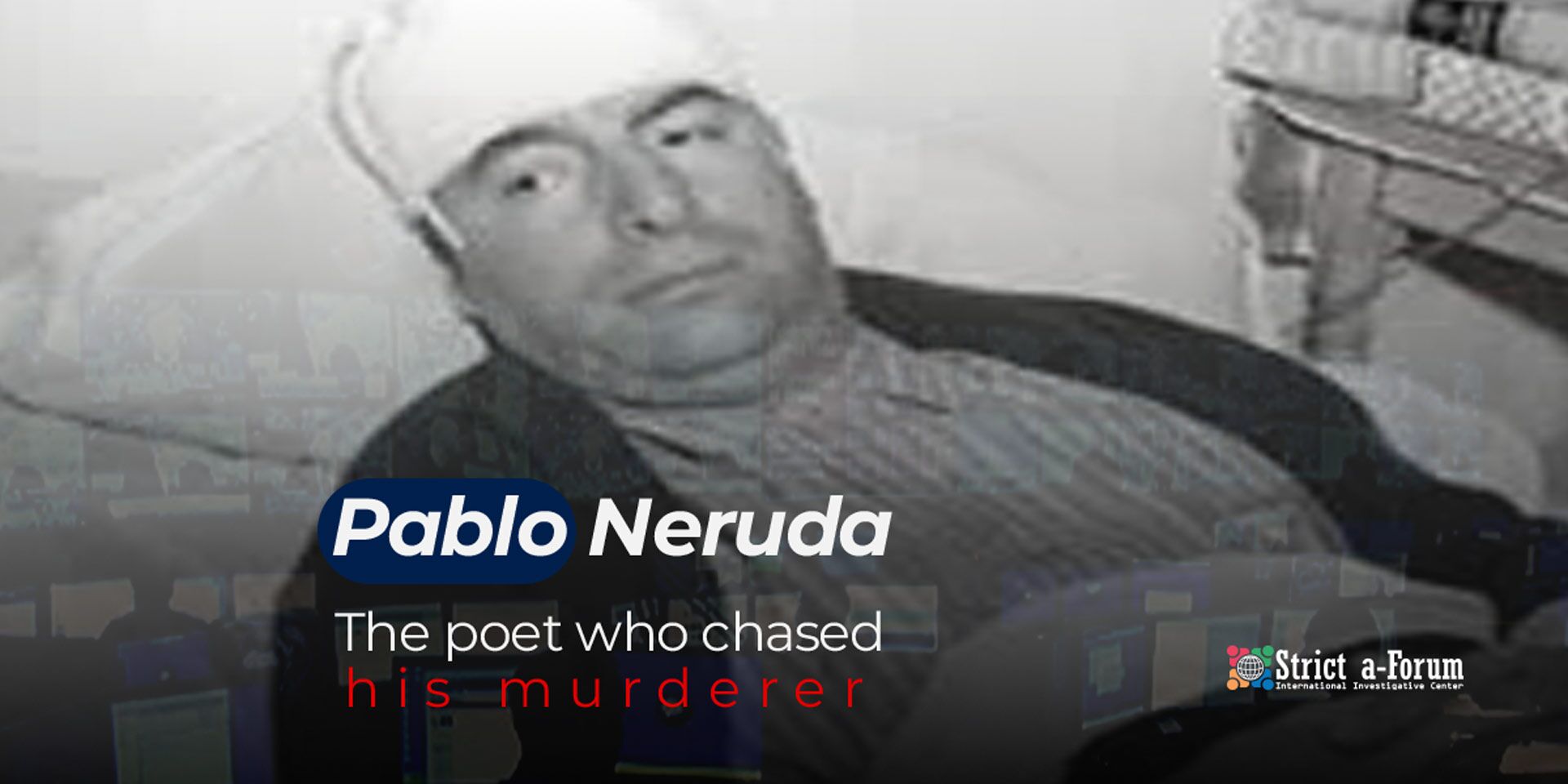
Forty two years after his death, the Chilean Ministry of Interior published a statement accusing Pinochet’s regime of planning to assassin the poet and diplomat Pablo Neruda.[1] Whether the accusations were valid or not, it is a fact that the war criminal imposed a curfew to prevent Chilean people from attending Neruda’s funeral in 1973, nevertheless, the public disobeyed his order and broke the curfew to attend the poet’s funeral in thousands.
Born in the 12th of July 1904, in Parral, Chile, to a father who worked as a railway employee and a Jewish mother who died two months after his birth, Ricardo Eliécer Neftalí Reyes Basoalto moved to Temuco with his father who married another woman. Ricardo wrote his first poem when he was ten, published his first essay when he was fourteen under the name of Neftali Reyes. As his father opposed his writing career, Ricardo adopted the pseudonym of “Pablo Neruda” in 1920.
When he moved to Santiago to study French in University of Chile, Neruda was able to publish his first volume of verse, “Book of Twilights” in 1923. Ricardo became a celebrity in his twenty, after the great success of his second work “Love Poems and Desperate Songs”. Nonetheless, he suffered a financial crises led him to accept working as a diplomat in British colonies.
[1] https://www.theguardian.com/books/2015/nov/06/chile-admits-pablo-neruda-might-have-been-murdered-by-pinochet-regime
The Spanish Civil war, burst in 1936, was a moment of revelation for Neruda who changed his route from a poet who writes about love and personal sufferings, experiments various forms of poetry to an ardent communist who is totally occupied by the public concern. His first work in supporting the Spanish Republic, “Spain in Our Hearts”, was published in 1938. He paid for his political stance when he lost his job as a diplomat.
However, he regained his job after the election of the Chilean president Pedro Aguirre Cedra and Neruda, as a diplomat, was responsible for transporting 2,000 Spanish refugees who had been housed by the French in squalid camps to Chile.
His literary maturity reached its peak in 1943, with his verse collection “Alturas de Macchu Picchu”. In 1945, he was elected a Communist Senator for the northern provinces of Antofagasta and Tarapacá in the Atacama Desert. After joining the communist party, the party was banned by González Videla. Moreover, in a long speech titled “I accuse”, Neruda led a fierce criticism against Videla in the Chilean Senate in 1948, after the repression of communist miners who were arrested and confined in concentration camps. In consequence, a warrant of arrest was issued against Neruda. He had to hide for thirteen months in the houses of his friends and supporters and in 1949 he fled to Argentina; he would not return to Chile for more than three years. In 1953, Neruda was the laureate of Stalin Peace Prize for his works in supporting Soviet Union. Neruda had many considerable reasons to support the Soviet Union, as a son of a Jewish mother, who suffered the Nazi persecution and as a communist, like many figures of his generation, the Soviet Union who defeated the Nazis and claimed to apply Marxism was an inspiration to many intellectuals of the age. Later on, Neruda rejected Stalinism along with Mao Tse-tungism, explaining that he can no more take “socialist deity”.
Being a bitter critic to the United States of America’s foreign policy, notably its action against Cuba and its war against Vietnam, the CIA considered Neruda one of its top targets, launching a campaign to defame him. The campaign paid off when Neruda was deprived from Noble Prize which went to Jean-Paul Sartre who rejected it.
However, the American write, Arthur Miller, managed to defy the ban against Neruda in the United States, and invited him to the PEN conference in New York City. In 1971, Neruda was awarded the Noble Prize.
Neruda was nominated to Chilean presidency in 1970, yet he rejected the nomination; instead, he announced his support to Salvador Allende. Assigned as an ambassador to France from 1970 to 1972, Neruda was able to negotiate on the Chilean external debt.
The year 1973 was a devastating one for Neruda; he was diagnosed with prostate cancer, a coup d’état was led and succeeded by Pinochet and Neruda thought that all hope for his life or for Chile’s future was lost.
Neruda’s works were extensive. But it is worthy to read some samples of it:
When I Die I Want Your Hands On My Eyes
When I die I want your hands on my eyes:
I want the light and the wheat of your beloved hands
to pass their freshness over me one more time
to feel the smoothness that changed my destiny.
I want you to live while I wait for you, asleep,
I want for your ears to go on hearing the wind,
for you to smell the sea that we loved together
and for you to go on walking the sand where we walked.
I want for what I love to go on living
and as for you I loved you and sang you above everything,
for that, go on flowering, flowery one,
so that you reach all that my love orders for you,
so that my shadow passes through your hair,
so that they know by this the reason for my song.[1]
Chant To Boliva
Our Father thou art in Heaven,
in water, in air
in all our silent and broad latitude
everything bears your name, Father in our dwelling:
your name raises sweetness in sugar cane
Bolivar tin has a Bolivar gleam
the Bolívar bird flies over the Bolivar volcano
the potato, the saltpeter, the special shadows,
the brooks, the phosphorous stone veins
everything comes from your extinguished life
your legacy was rivers, plains, bell towers
your legacy is our daily bread, oh Father.[2]
[1] https://www.familyfriendpoems.com/poet/pablo-neruda/poems/
[2] https://allpoetry.com/poem/14326621-Chant-To-Bolivar-by-Pablo-Neruda


